

Essential Resources Every HR Professional Should Know

HR professionals are expected to navigate evolving employment laws, shifting workforce expectations, workplace technology, and talent shortages, often simultaneously. Staying effective requires more than experience alone. It requires continuous learning and access to trusted resources that support better decisions, stronger compliance, and long-term career growth.

Fortunately, a wide range of professional associations, industry publications, and compliance resources can help HR professionals stay informed, adapt to change, and confidently address both day-to-day challenges and long-term strategic priorities.

In today’s workplace, staying informed is no longer optional. It’s a competitive advantage.

HR Association Memberships

Professional associations provide access to industry insights, certifications, seminars, research, and ready-to-use templates and tools. While many offer similar benefits, each specializes in different areas of HR, making it important to choose resources that align with your professional goals and business needs.

  • Society for Human Resource Management (SHRM) is one of the largest HR associations globally. SHRM offers broad HR expertise, professional development opportunities, strategic management insights, and widely recognized certifications.
  • Human Capital Institute (HCI) focuses on talent strategy, workforce planning, leadership development, and upskilling. It is particularly valuable for HR professionals looking to strengthen their impact on organizational performance and business strategy.
  • WorldAtWork offers research, salary benchmarking tools, and educational resources. Known for its expertise in compensation and total rewards, the organization also provides the Certified Compensation Professional (CCP) designation.
  • American Staffing Association (ASA) specializes in recruiting and staffing and offers the Certified Staffing Professional (CSP) certification. The association provides guidance on staffing laws, regulations, and recruiting compliance.
  • CalChamber is a valuable resource for California employers, offering state-specific compliance guidance, employment law updates, training resources, and workplace policy tools.

Newsletters and Blogs

Continuous learning doesn’t always require a membership. Many valuable industry insights are available through free publications and newsletters. These resources complement association memberships and provide an easy way to stay informed about workplace trends, hiring practices, compliance developments, and emerging HR challenges.

  • HRBrew delivers workplace news in a concise, easy-to-digest format, making it ideal for busy HR professionals looking to stay informed on current trends.
  • LinkedIn Talent Blog leverages insights from LinkedIn’s professional network to cover recruiting trends, hiring strategies, workforce data, and talent management best practices.
  • HR Dive combines daily HR news with deeper analysis, helping professionals understand not only what’s happening in the industry, but also why it matters and how it may impact their organizations.

Employment Law & Compliance Updates

Compliance remains one of the most important responsibilities within HR. Because employment laws and workplace regulations change frequently, HR professionals benefit from relying on trusted compliance resources that provide timely updates and practical guidance.

  • Employment Law Firm Publications can offer practical interpretations of new legislation, workplace policies, court rulings, and other developments affecting employers.
  • Government Agencies such as the Employment Development Department (EDD), Department of Labor (DOL), and state labor agencies provide official guidance, regulatory updates, and employer resources designed to help organizations remain compliant.

Investing in Your Growth

The most effective HR professionals combine industry knowledge,Ftech compliance expertise, and continuous learning to stay ahead of change.

By leveraging a mix of professional associations, trusted publications, and compliance resources, HR leaders can make more informed decisions, support their organizations more effectively, and continue advancing their careers.

Whether you’re looking to expand your expertise, pursue new opportunities, or take the next step in your HR career, Century Group is here to help.

Q4 2026 Employment Report: Selective Hiring, Competition for Talent Continues

By Ron Blair, President & COO, Century Group

Employers are scrutinizing headcount while continuing to compete for accounting and finance professionals who protect reporting quality, improve cash flow, and turn financial data into decisions.

The latest labor market data suggests that while hiring activity has become more selective, the underlying need for experienced finance and accounting professionals has not gone away.

Job Growth & Unemployment Remain Stable

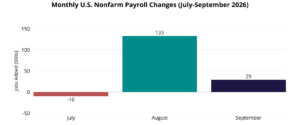
Bureau of Labor Statistics (BLS) reports 29,000 additional nonfarm jobs in September and an unemployment rate of 4.2%.

Revisions to July and August payrolls brought total job gains over the three-month period to 152,000, averaging just over 50,000 jobs per month. While layoffs remain relatively low, recent hiring activity points to a labor market that is stabilizing rather than accelerating.

Employers have not stopped hiring, but many organizations are becoming increasingly selective about where they invest in new headcount.

Figure 1. Source: BLS, U.S. nonfarm payroll changes, seasonally adjusted. July and August revised; September preliminary.

The Key Distinction for Finance Leaders

“Financial activities” describes an industry, including banking, insurance, and real estate. It does not measure finance professionals across all employers. Similarly, accounting-firm payrolls include multiple occupations and exclude corporate accounting departments in other industries.

No single labor market indicator tells the full story. Finance leaders should evaluate multiple data points to understand the true demand for accounting and finance talent.

Accounting Talent Remains Scarce

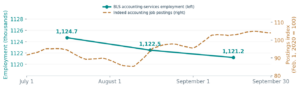
According to BLS, payrolls in accounting, tax preparation, bookkeeping, and payroll services totaled 1,121,200 in September, down 1,300 from August and 7,300 from September 2025 (−0.6%). Professional employment declined, while Indeed accounting posting rose 11.1% from July to September on a monthly-average basis.

The contrasting data points illustrate an ongoing trend in the accounting labor market. Demand for accounting professionals has been increasing for years. At the same time, the number of individuals entering these professions continues to decline. The ongoing wave of Baby Boomer retirements only adds to the pressure.

Figure 2. Left: BLS, monthly payroll employment, plotted at mid-month; August/September preliminary. Right: FRED, daily accounting postings index via FRED, July 1–September 30, 2026 (7-day trailing average). Both seasonally adjusted; different coverage and scales.

An AICPA & CIMA survey found that 33% of executives reported too few employees, up from 28% in Q2. This is critical because 49% expected business expansion over the next year. The combination suggests hiring needs remain elevated in corporate finance and highly elevated in accounting departments.

Audit Teams Face Budget Pressure

The Institute of Internal Auditor’s (IIA) found that the share of internal audit functions reporting budget cuts rose from 11% in 2024 to 19% in 2025, with staff cuts rising from 11% to 18%. Financial services stood apart: 32% reported staff growth in 2025. A core reason for the decline in Audit department staffing levels is the increased use of Automation tools and AI in core audit planning, testing, and fieldwork.

Expertise & Technology Shape Tax Opportunities

Thomson Reuters Institute’s State of Tax Professionals report describes persistent talent shortages alongside expansion into tax strategy and business advisory. Its global findings suggest that experienced professionals who combine technical judgment, client communication, and efficient workflows remain valuable.

Technology is also influencing recruiting and retention decisions. A separate survey found that 26% of tax and audit professionals would decline a role without professional-grade AI access.

The finding supports that technology access and AI training are becoming part of the employee value proposition.

Hiring Priorities for 2027

Taken together, these indicators point to a labor market that remains selective but competitive. While overall hiring growth has slowed, demand remains strongest for professionals who combine technical expertise, business judgment, and adaptability.

  • Accounting and controllership. Prioritize close reliability, technical reporting, reconciliations, and team leadership. Define the business problem a new hire must solve before opening the search.
  • Finance and FP&A. Seek professionals who can model cash needs, test scenarios, explain variances, and translate forecasts into operating decisions.
  • Audit and controls. Connect staffing requests to material risk and the audit plan. Consider targeted interim or co-sourced expertise when ongoing headcount is constrained.
  • Tax. Plan capacity around compliance deadlines and advisory commitments. Assess review skills, technical depth, client service, and technology proficiency together.

For professionals, the strongest positioning is evidence of results: a faster close, better cash visibility, stronger controls, or clearer advice. For employers, disciplined selection should be paired with timely decisions, credible development opportunities, and realistic workload expectations.

At Century Group, we work closely with organizations navigating these same hiring challenges every day. Despite a slower labor market, competition for experienced professionals remains very real. Connect with our team to discuss your accounting and finance hiring needs.

Sources