- Employers


- Job Seekers
5 Questions to Ask Before Accepting a Job Offer

- About Us
The Accounting Talent Shortage Is No Longer a Forecast—It's Here
- Resources
2026 Salary Guide




By Ron Blair, President & COO, Century Group
Employers are scrutinizing headcount while continuing to compete for accounting and finance professionals who protect reporting quality, improve cash flow, and turn financial data into decisions.
The latest labor market data suggests that while hiring activity has become more selective, the underlying need for experienced finance and accounting professionals has not gone away.
Bureau of Labor Statistics (BLS) reports 29,000 additional nonfarm jobs in September and an unemployment rate of 4.2%.
Revisions to July and August payrolls brought total job gains over the three-month period to 152,000, averaging just over 50,000 jobs per month. While layoffs remain relatively low, recent hiring activity points to a labor market that is stabilizing rather than accelerating.
Employers have not stopped hiring, but many organizations are becoming increasingly selective about where they invest in new headcount.
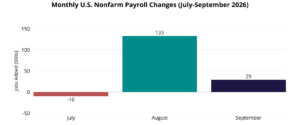
Figure 1. Source: BLS, U.S. nonfarm payroll changes, seasonally adjusted. July and August revised; September preliminary.
“Financial activities” describes an industry, including banking, insurance, and real estate. It does not measure finance professionals across all employers. Similarly, accounting-firm payrolls include multiple occupations and exclude corporate accounting departments in other industries.
No single labor market indicator tells the full story. Finance leaders should evaluate multiple data points to understand the true demand for accounting and finance talent.
According to BLS, payrolls in accounting, tax preparation, bookkeeping, and payroll services totaled 1,121,200 in September, down 1,300 from August and 7,300 from September 2025 (−0.6%). Professional employment declined, while Indeed accounting posting rose 11.1% from July to September on a monthly-average basis.
The contrasting data points illustrate an ongoing trend in the accounting labor market. Demand for accounting professionals has been increasing for years. At the same time, the number of individuals entering these professions continues to decline. The ongoing wave of Baby Boomer retirements only adds to the pressure.
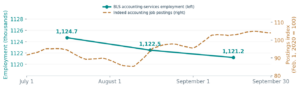
Figure 2. Left: BLS, monthly payroll employment, plotted at mid-month; August/September preliminary. Right: FRED, daily accounting postings index via FRED, July 1–September 30, 2026 (7-day trailing average). Both seasonally adjusted; different coverage and scales.
An AICPA & CIMA survey found that 33% of executives reported too few employees, up from 28% in Q2. This is critical because 49% expected business expansion over the next year. The combination suggests hiring needs remain elevated in corporate finance and highly elevated in accounting departments.
The Institute of Internal Auditor’s (IIA) found that the share of internal audit functions reporting budget cuts rose from 11% in 2024 to 19% in 2025, with staff cuts rising from 11% to 18%. Financial services stood apart: 32% reported staff growth in 2025. A core reason for the decline in Audit department staffing levels is the increased use of Automation tools and AI in core audit planning, testing, and fieldwork.
Thomson Reuters Institute’s State of Tax Professionals report describes persistent talent shortages alongside expansion into tax strategy and business advisory. Its global findings suggest that experienced professionals who combine technical judgment, client communication, and efficient workflows remain valuable.
Technology is also influencing recruiting and retention decisions. A separate survey found that 26% of tax and audit professionals would decline a role without professional-grade AI access.
The finding supports that technology access and AI training are becoming part of the employee value proposition.
Taken together, these indicators point to a labor market that remains selective but competitive. While overall hiring growth has slowed, demand remains strongest for professionals who combine technical expertise, business judgment, and adaptability.
For professionals, the strongest positioning is evidence of results: a faster close, better cash visibility, stronger controls, or clearer advice. For employers, disciplined selection should be paired with timely decisions, credible development opportunities, and realistic workload expectations.
At Century Group, we work closely with organizations navigating these same hiring challenges every day. Despite a slower labor market, competition for experienced professionals remains very real. Connect with our team to discuss your accounting and finance hiring needs.
Sources