Leadership Transition Underway At Securities and Exchange Commission

On November 26, Mary Schapiro, the current chair of the U.S. Securities and Exchange Commission (SEC), announced that will she retire before the end of the year.

On November 26, Mary Schapiro, the current chair of the U.S. Securities and Exchange Commission (SEC), announced that will she retire before the end of the year.

The move was widely anticipated, and is only one of the many high-level personnel changes that are expected to be announced by the Obama Administration as it gears up for a second term in office. We recently discussed a number of other staffing adjustments and regulatory developments that are believed to be forthcoming.

Schapiro was first nominated to head the SEC in 1988 by President Reagan. She served until 1994, when President Clinton appointed her as chair of the Commodity Futures Trading Commission. She returned to the SEC at the beginning of President Obama’s first term in 2009 and is currently the only person to have ever chaired both organizations.

In a statement announcing her retirement and reflecting on her tenure, Schapiro praised her colleagues and the actions taken by the commission in the wake of the financial crisis.

“It has been an incredibly rewarding experience to work with so many dedicated SEC staff who strive everyday to protect investors and ensure our markets operate with integrity,” said Schapiro. “Over the past four years we have brought a record number of enforcement actions, engaged in one of the busiest rulemaking periods, and gained greater authority from Congress to better fulfill our mission.”

Her departure comes at a critical time for the SEC. The regulatory body is currently struggling to adapt to long-term structural changes in U.S. financial markets, including the rise of high-speed computerized trading. As we’ve discussed, this particular trend is challenging the SEC’s ability to monitor and respond to events as they develop.

U.S. businesses are also under pressure due to changes in the economy. Companies are being forced to cut costs while remaining competitive, which can cause considerable stress. The experts at a financial project consulting service can help.

5 Steps to Making the Right Hire

The Department of Labor has reported that unemployment for individuals with college degrees has trended below 2.5%* nationally. The competition for quality professionals is at an all-time high. What can you do to ensure you have the right talent on your team? Make sure you have the best process for making the best hires. © Atee83 | Dreamstime Stock Photos

STEP 1: The Process

Mitigating the risk of making the wrong hire involves having a good and clearly defined interview process. Eliminate unnecessary steps before bringing candidates in for interviews: decide who is going to interview and define their role, and then have every candidate go through the same process. If you need more than one person’s buy-in, understand which interviewers are assessing culture fit and which are assessing skill. With too many people involved in the process, interviewing can turn into a popularity contest. You want feedback about how the candidate can perform the duties and how they can fit in with the culture. Professional relationships and friendships will develop on the job after everyone has had an opportunity to work together, provided the candidate fits the culture.

STEP 2: The Goal

To fill an opening, you need to evaluate the candidates relative to the position. Regardless of the number of candidates for a particular opening, the measure should be against the job requirements and the specifications, not the other candidates available to interview. Don’t let interviewing take precedent over hiring. If you aren’t seeing the candidates you need, adjust the position requirements or expand your network. When you find a candidate that has potential for the job, run them through the process. They either are right or they aren’t; make a decision and move on.

STEP 3: The Challenge

When working with your recruitment partner and designing a job specification, determine what skills are essential and what can be developed. Candidates that have to stretch for a particular job are often motivated to perform beyond someone that has “been there done that.” By hiring candidates that have the essential skills for the position and letting them grow into the job, you will end up reducing self-selected turn-over of employees desiring a challenge. Hire the candidate that wants the challenge and the job.

STEP 4: The Compensation

Compensation isn’t the number one reason that people accept a new job, but when it’s too low, it’s the number one reason candidates turn down a job offer. There is a general market rate for the skills and background you are seeking. Most candidates have a good understanding of the compensation range that applies to their skill and the career opportunities they’re seeking. They know what peers are earning; they have access to online salary resources and, of course, they have their current salary and benefits as a point of reference. Align yourself with the resources that make you informed. If your company doesn’t have a wage and compensation department, check the available resources from recruitment providers, industry associations and your own professional network.

STEP 5: The Authority

Determine who has authority to make the hiring decision and the offer up front, and make sure they take responsibility for the success of the hire. Integration and training are an important part of making a successful hire. Empower yourself and/or your staff to make a decision they will live with. If you are delegating the decision, make it clear to your subordinates. If you want to retain control, outline the influence the subordinate will have in the process. Ultimately, I have found that letting my subordinates make their own decisions and being there as a sounding board garners great results.

With these tips, successfully navigating the hiring process becomes more efficient and effective, maximizing the time and resources spent to make the best hire possible.

Click here to learn more about our approach in helping you with that hiring process.

*This article originally appeared in the January 5 issue of the Orange County Business Journal; the unemployment figure has been updated to reflect the most recent data.

CFO should be in place before additional hires can be made

CIOs are unique in that many of them are responsible for business processes influenced by technology, which is constantly evolving.

Different companies view their CIOs differently, whether this executive is responsible for information, innovation, improvement or intelligence processes within a company.

When CFOs are tabulating their long-term outcomes, they must consider the role that other senior executives, especially CIOs, will play in a business’s development. CIOs are unique in that many of them are responsible for business processes influenced by technology, which is constantly evolving.

As such, CFOs face a challenge in determining how these executives fit into an organization’s long-term financial planning.

“Since building rather than buying brings some serious benefits when it comes to finding future leaders, it behooves CFOs to think about what kind of CIO their company will need to employ down the road,” according to a February CFO.com article. “Better to identify the right kind of leader and groom him or her than to do a rip and replace at the 11th hour.”

As deeply invested as CIOs are in using technology to solve problems, there may be other tools they can use to achieve more efficient and expedient outcomes. CIOs should be flexible and consider solutions that primarily use information to address problems, not necessarily technologically advanced platforms.

CFOs need to decide what their best solution could be for hiring those who fulfill senior information and intelligence jobs. Many organizations have begun outsourcing some process related to information sharing, including telephone answering services and cloud computing. For some businesses – such as J.C. Penney, which recently eliminated its CIO position – these third-party services are more affordable than hiring in-house experts.

Before making this determination, companies should first ensure they have the right CFO for their needs. When headhunting CFOs during a financial professional search, companies should work with job search firms that have experience connecting companies with the right senior executive. Once this CFO is hired, a company can begin its long-term organizational planning.

Optimism climbing among mid-market CFOs

The number of CFOs planning to hire workers increased six basis points to 74 percent, while 81 percent now expect their profits to stabilize or improve

Despite lagging unemployment numbers, many in the business world are still somewhat optimistic that a sluggish economy is on the verge of improvement, according to a recent survey of second quarter CFO attitudes by GE Capital.

Although CFOs expressed concerns over business costs, it appears as though these worries peaked last quarter. The number of CFOs planning to hire workers increased six basis points to 74 percent, while 81 percent now expect their profits to stabilize or improve – eight points higher than the first quarter.

“Mid-market CFOs are more optimistic than six months ago, despite the European fiscal crisis and inconsistent job growth,” GE Capital Americas president and CEO Dan Henson said in a press release. “A larger majority sees top-line growth and stable or better profits this year, and more will be hiring. These companies have access to affordable capital, which in 2012 is most likely to be targeted for investment to finance growth and to purchase equipment.”

Despite optimism on the mid-market side – businesses with an average annual revenue of $143 million – small business executives experienced a drop in optimism last month. Last week, the National Federation of Small Business released its March small business optimism index, which determined that positive business sentiment fell from 94.3 in February to 92.5 in March. Contained within this drop is a leveling off of feeling regarding hiring, which had increased for six consecutive months.

As CFOs continue to plan for the rest of this year, those who have the means to hire new employees should turn to headhunting firms with experience identifying talented financial professionals. Whether recruiting for auditing positions or filling accounting, tax and corporate vacancies, a professional recruitment firm can expand the pool of qualified candidates and expedite the process.

War for talent and human capital reaches frenzied state

This iteration of the talent war may not be as forgiving to companies that are unable to identify and retain the most talented workers.

For those familiar with the business landscape, the last few years have been marked by companies simply trying to survive through any means necessary. Whether this means laying off employees or cutting back key services, business executives have been required to make difficult austerity decisions. As economic conditions have improved, however, employees are becoming more mobile and companies are filling their staffs with high-quality workers.

Writing for Ere.net, human resources expert Dr. John Sullivan cautions employers that they could be left on the sidelines as the war for talent escalates. The long-term implications of not hiring top industry talent are dire and could set a company back several years.

“To those and others that may have forgotten what it was like [during the first talent war in 1999], remember that even though talent management received a great deal of attention and boatloads of money, it was not a good time,” Sullivan writes. “If you weren’t prepared, days were long and hectic and even with unlimited resources, it was a struggle to hire and retain even mediocre workers.”

This iteration of the talent war may not be as forgiving to companies that are unable to identify and retain the most talented workers. An investment in a new employee or the retention of a long-term worker enhances an organization’s human capital, which, if maintained correctly, will benefit the company down the road. Higher up-front hiring and training costs can be justified if employees remain with organizations for a significant amount of time.

The long-term thinking that is required of hiring managers should also be utilized by CFOs and financial executives who are partially responsible for bolstering their talent bases. When searching for talented accounting and finance professionals in this highly competitive atmosphere, organizations should seek the assistance of professional recruiters, which can prove to be vital allies in the war for talent.

Self-confidence correlates strongly with business success

An individual’s belief in his or her own abilities is a significant determinant in workplace performance, even more so than upbringing.

They have been called “deciders” and “drivers,” but regardless of their specific title, all business should be fiercely competing to hire these decisive decision makers.

In a recent Ere.net piece, Nick Tasler delves into the issue of decision-making as it relates to business professionals. He cites a study by Timothy Judge from the University of Notre Dame that found that an individual’s belief in his or her own abilities is a significant determinant in workplace performance, even more so than upbringing.

“The supremely confident sons and daughters of roofers and plumbers who had only mediocre SAT scores and below average grades earned a 30 to 60 percent higher income than the smart kids with dreary views of their abilities,” according to Tasler. “And those kids with all the advantages of intelligence and pedigree plus a firm belief in their competence earned three times as much money as their equally blessed peers.”

In addition to finding workers who have displayed an innate ability to make decisive decisions, companies need to find CFOs, financial professionals and other high-level business leaders who boast a certain personality type. A recent study cited by CFO World found that 77 percent of successful CEO and CFO dyads had at least one “driver” – a analytical, decisive and pragmatic business leader. The other personality types – integrators, guardians and pioneers – were not observed nearly as often.

Businesses in search of drivers and deciders may not have the resources to find these leaders on their own, so some rely on third-party job search firms when recruiting managers. These organizations can also conduct a financial professional search as needed, by sifting through high-quality applicants currently employed by other companies.

5 Tips to Improve Your Recruitment and Selection Process

By Ron Proul, CEO

Right now, with unemployment at less than 5%, companies are reaching out to us to fill their openings and looking for results. The government says 5% unemployment is a healthy unemployment level, considering it “full” employment. With the current unemployment rate at 4.4%, recruiting’s best practices are under heavy scrutiny as during a full employment market, recruiters, more than ever, hear… “Hey, where are all my candidates and why aren’t we seeing anyone?” Unfortunately, it’s typically a lack of understanding of how a contingency recruiter works combined with what companies do to hinder the process that creates this vacuum in the search process.

Contingency recruiters work on a success fee basis; they work on multiple openings to spread the risk of investing time without a return on investment. Companies that don’t understand this reduce the effectiveness of a success-fee relationship usually without taking notice of the very things they can control that will increase the effectiveness of the process.

Here are some behaviors that may be hindering your recruiting department from taking full advantage of your contingency search partners and some simple solutions:

1. Hurry up and wait

We have all seen this scenario first hand – the mandate is issued; this is an important job; we need all hands on deck; we want this person hired immediately! Every agency is called; the job is posted all over the Internet on job boards, social media, and association web sites. Soon, you discover every candidate you talk to has heard about the opening, submitted a resume and referred a friend. But wait, no one has had an interview. The human resources person, usually working on 20 other open requisitions, has no time to follow up with agency submissions, ad responses or referrals. The sense of urgency has grounded to a halt.

Now when you talk with a possible candidate, you both agree that the job must have been filled because no one has heard back. You take your ball and go home but just then, the phone rings the company frantically declares, “The search is on, we need people.” But wait, everyone you’ve already submitted has a job, candidates have lost interest, candidates think there must be something wrong with the job, and as a recruiter, you can’t afford to invest any more time on contingency because the possible return on your investment is close to zero. You have a lot of other serious employers that need your attention instead.

SOLUTION: To avoid the fire drill, be selective with postings to sources that present the opportunity to the right community. Select recruitment partners that specialize and have your trust. Most of all communicate the timeline for the hire. If you aren’t ready to move, don’t post the job, but rather conduct a more deliberate search through your partners with the understanding the select candidate drives the process. If it is all hands on deck, fewer rather than more partners may produce better results, so they can focus and afford to invest the time.

2. Let me phone screen first

The whole recruiting industry has this wrong and it drives me nuts. This is a lazy, half-hearted, useless exercise which makes internal hiring authorities fool themselves into thinking that they are doing something to fill their job. Usually, a person who isn’t qualified to do a technical interview, (the only kind of phone screen that can be acceptable), gets on the phone with a few basic questions that really don’t tell you how legitimate a candidate is. A phone interview takes as long as an in-person interview; is usually followed by an in-person interview and drags the process out longer than necessary. An interview process viewed as too long has been identified as a sure-fire way to lose good candidates. For some reason, the phone interview was supposed to improve the process – not true. Most of the time a phone screen can eliminate candidates who do not represent well in a phone interview, but are much better in person. Or once you like them on the phone, you set them up only to find that the candidate isn’t serious enough to make an in-person interview let alone a job change. Worse yet, the candidate was turned off during the phone screen. You invested a half hour only to find when the candidate came in that they weren’t a good chemistry fit or were already off the market. There is no such thing as a phone screen in a full employment market. If you are not selling the minute you get on a phone and advocating for your company, you are at a disadvantage to companies and recruiters that are.

You need to meet people to hire them; why are you avoiding the very activity you need to do to make a timely hire? When you call a candidate, it is to advocate for the company and sell the opportunity to invite them in for an in-person interview, so that a legitimate evaluation of the entire candidate can take place.

SOLUTION: To entice your partners don’t be the roadblock with a phone screen, recruiters won’t waste your time with inappropriate candidates because they’ll see that you understand the process and as such, are a valuable client. Candidates seeing the environment they will work in is part of your recruiting process. Ask your partners to set up their top three candidates for an in-person interview. If they are a specialist and experienced, your search partners will take care of your time, and if they don’t they are the wrong partners.

3. Your company has a bad reputation

This form of denial is dangerous. Company culture and morale are cornerstones of recruiting and of keeping productive employees, so it is amazing to me when there is a problem in the market with a company’s reputation and the company is slow to react. To be fair, usually it isn’t the whole company; it’s a department or a segment within the company. When the issues are primarily a manager that is highly-productive and creates value in other ways, taking notice can be difficult, but turnover should never go unnoticed. Nonetheless, when the feedback is given the client usually says things like, “Well, we only want the best and so we are not the place for everyone” or “That candidate wasn’t that good.” You hired them…so you’re saying that you aren’t that good at hiring, onboarding, training and developing? Rather than taking a hard look at the pattern, the company usually blames the candidate or the recruiting firm. Stop! After two bad hires, recruiters get the picture; why don’t companies see that themselves?

SOLUTION: IF you are sensing a problem ask for feedback. Make sure you are doing exit interviews, Ask your recruiting partners what they are hearing in the marketplace. Ask if they are seeing resumes from your firm coming in from job postings. You don’t need to put them on the spot by asking for the names but most recruiters can tell you what they see and hear in the marketplace. Remember a good recruiter is talking with everyone working or not.

4. It’s your problem now

Companies with turnover resort to demanding lower recruiting fees because they say they’re paying too many. And they request longer and longer …and longer guarantees on candidates placed. Any self-respecting recruiter knows what a long guarantee is symptomatic of, he or she should run for the hills at that point. It’s amazing that companies themselves don’t see it. I interpret it like this – rather than taking responsibility that the company has difficulty finding and keeping good employees, “We want you, Mr. /Mrs. Recruiter, to work twice as hard to overcome our reputation, work for a lower fee (if we pay you at all), because we want you to take on the entire risk of how we treat our employees by extending your guarantee.” Sorry, no can do Mr./Mrs. Employer; next!

SOLUTION: Just don’t do this! Pay a market fee, and a standard guarantee to get the best to work. If a recruiter accepts this type of arrangement chances are you are getting what you pay for.  Even during the downturn, we held our fee schedule and guarantee schedule. Guess what? My staff prospered and continued to service the clients that valued our service. It is one thing to “take a job order” it is a completely different amount of effort to “work a search” and go find someone that isn’t actively looking. Without a competitive structure, you will only get the candidates that other clients already passed on.

5. They are already in my database

I love this one. Some CRM or vendor management service has sold a company on a product to solve all of their recruitment deficiencies. They promise you the CRM will capture all the resumes and submissions in the database so that your recruitment professionals can search, source and keep recruiters from earning fees for prior candidates submitted to the company. The one problem is no one knows how long, or how, to keep the information up to date. There is really no incentive for the internal recruiting people to continually mine and update the database prior to an opening so when an opening comes up, the CRM information is old, or worse yet, trapped in the system never to be accessed. Then, a recruiter is hired because the company’s internal resources weren’t successful. The recruitment firm actively sources, recruits, and submits the perfect resume only to be told, “It’s already in my database,” or, “I’m connected to them on LinkedIn so we aren’t going to pay your fee.” Wait one minute, you have the candidate in your database and couldn’t make the match until I pointed it out? Shame on you, as if someone in your database is more valuable than the work the recruiter put in to match and attract the candidate for this very opening that you couldn’t fill. Can recruiters earn a fee just for having someone in a database without making a match, pre-qualifying and convincing the candidate the job is right for them? No, they can’t! Three things happen with companies that repeatedly do this to recruitment partners, (1) the recruiter asks the candidate where the mix up is and usually the candidate says, “I haven’t applied there for two years or talked to them” …then… the next two things happen; (2) the external recruiters stop working hard to find anyone and (3) starts ensuring that particular candidate has as many interviews as possible and is off the market before the company can phone screen them. Yes, companies that have a database searching problem usually have a “hurry up and wait” or a “phone screen problem”.

SOLUTION: There is only one solution for this, a well structured and fair agreement with your search providers. One that spells out how long a providers referral is good for and as a client you are held to the same standard. Make sure there is a clear definition of a referral and the standard to be considered a referral spelled out. Everyone one likes to know the rules of engagement. Comes right down to business ethics and codes of conduct in commerce.

So now you say… “Where are all my candidates?

Learn more about our approach and expertise in helping you with your hiring process.

Q3 Accounting & Finance Employment Report

By Ron Blair, COO & Managing Director 

The overall pace of job growth continued with a slight hiccup in September as employers appeared to shed 33,000 jobs. We say “appeared” because expectations are that these job losses will be short lived and are likely the result of hurricane related issues and not a change in the underlying labor-market. In fact, nearly 1.5 million people reported in September that they had a job, but were not at work due to “bad weather”. This was the highest number seen since 1996 when powerful blizzards hit the East Coast. Most of these appear to come from the Leisure and Hospitality sector in the affected regions.

CONTINUED JOB GAINS FOR ACCOUNTING & FINANCE PROFESSIONS

The fact remains that in 2017 employers have added an average of 148,000 jobs per month, while this is down from a monthly average of 187,000 in 2016 — job gains remain steady.

More importantly for Accounting and Finance professionals are the job gains numbers for Professional & Business Services and Financial Activities. These sectors combined added 23,000 jobs from the previous month – the largest area of growth and ahead of Healthcare. Additionally, there has not been a negative change month-to-month for employment in Professional and Business Services since January 2016.

DECLINING UNEMPLOYMENT RATES:

U.S Bureau of Labor Statistics Unemployment Rate Chart

The unemployment rate declined 0.2% in September to reach 4.2% – the lowest unemployment rate seen since early 2001. The unemployment rate has remained below 4.5% for the past six months and remains below the level that the Federal Reserve considers “normal” and below the rate that many economists consider “full-employment”.

LOW UNEMPLOYMENT RATE FOR COLLEGE GRADUATES:

U.S Bureau of Labor Statistics Unemployment Rate Chart

The story gets better for college graduates. As the chart above shows – unemployment for candidates with a bachelor’s degree or higher is even lower than the 4.2% rate for all workers, hovering at 2.3%-2.4% over the last five months.

FULL EMPLOYMENT FOR ACCOUNTING & FINANCE PROFESSIONALS

The high demand for and limited supply of Accounting and Finance professionals with a combination of specialized knowledge, training and experience has driven the unemployment rate for these candidates even lower – and demonstrates how challenging the market is for those looking to hire and how strong the market is for candidates in today’s accounting and finance job market. Current unemployment rates for selected categories are listed below:

  • Financial managers: 1.8%
  • Bookkeeping, accounting, and auditing clerks: 2.0%
  • Accountants and auditors: 2.2%
  • Financial analysts: 2.5%

The bottom line, finding candidates has never been more challenging. This is great news for Accounting and Finance Professionals and provides a partial answer to Hiring Manager’s question “Where are all of my candidates?” They’re working.

Contact us today to help with your recruiting needs or search for a new job.


Hiring and Compensation Heating Up for Financial Professionals

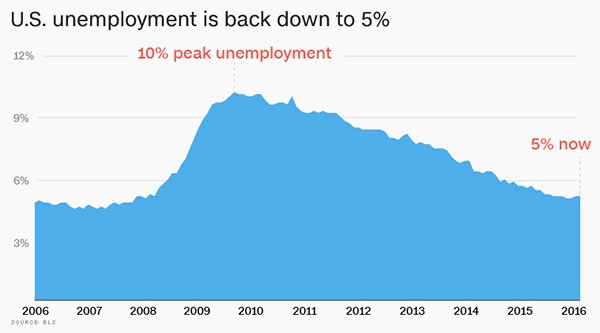
The Fed has achieved one of its two goals – full employment.

So says John Williams, president of the San Francisco Federal Reserve. He reported that the U.S. economy is back on track and we’re basically at full employment, signaling an end to America’s job crisis.

And as the economy improves, signs are pointing to continued good news throughout the rest of the year. Among them, the strength of retail sales; manufacturing, factory and industrial output; home building; and an increase in discretionary spending.

Two home improvement giants – Home Depot and Lowes – both reported strong first quarters in 2016, as the investment value in home ownership rises. “We’re seeing continued improvement in the job market, we’re seeing continual improvement in wages, we’re seeing continued improvement in home values. It’s driving continued improvement in their intentions for discretionary spending,” Lowe’s CEO Robert Niblock said in a recent Quartz article.

The evidence is clear given we’ve had one of the healthiest labor markets in decades over the last few months. The number of workers applying for new unemployment benefits reached its lowest level since late 1973, and jobless claims maintained the longest streak below 300,000 since the early 70’s as well. “The fact that the numbers continue to ratchet down suggests that labor demand is strong and a sign the labor market should continue to improve,” Chief Economist Timothy Hopper of TIAA Global Asset Management shared in a recent Wall Street Journal article.

Although wages are rising more slowly than previous economic recoveries, the steadying of unemployment at 5% has increased wage growth as employers boost salaries to retain talent. ADP’s Workforce Vitality Report for Q1 reported that full-time workers in finance and real estate saw an average 5.3% increase in wages, up 1% from the year prior, while those switching jobs in the same category saw a 6.7% increase in wages.

Bloomberg BNA said the rate of wage growth for most workers in the U.S. will likely continue to increase in the second half of the year. Kathryn Kobe, an economist who works with Bloomberg BNA, said she expects the rate to improve between 2.5 and 3% through the rest of the year. Wages previously increased from 3.3 to 3.6% pre-recession.

“This may be a signal that continued employment growth is leading to a smaller pool of available talent, in turn motivating employers to increase wages to retain experienced workers,” Ahu Yildirmaz, head of the ADP Research Institute, said.

The increase in competitive wages, coupled with the highest rate of employee confidence in 7 years, means workers are gaining leverage. And while businesses still plan to hire staff throughout the year, finding the right talent has once again become as the main concern – and the main challenge to company growth – for the first time since the pre-recession economy, especially given the increase in retirements and entry level candidates without the necessary skills.

Q1 Accounting & Finance Employment Report

By Ron Blair, COO & Managing Director

Are We At Full Employment?

The Wall Street Journal surveyed 68 economists to weigh in on this very question — they answered as follows:

  • 42% — YES
  • 48% — NO, but it’s close
  • 9%  — NO, and it’s not close to full employment

So what does this mean for financial professionals and the employers who need them? COO and Managing Director, Ron Blair, provides his insight and expectations for Q1 and Q2 2018.

Unemployment Rate: 4.1%


THE ECONOMY & EMPLOYMENT BY THE NUMBERS

The current economic statistics are telling. The momentum in interim and project services continues to be positive due to GDP growth and the expected effects of lower corporate tax rates. And with GDP forecasts of 2.5% growth in Q1 and Q2 of this year, employment growth is anticipated to follow suit.

Breakdown by the numbers to help put the market in perspective:

  • 3.2% GDP Growth Rate — Q3 2017
  • 4.1% Unemployment Rate — lowest since late-2000. The rate is below what the Federal Reserve forecasts as the economy’s long-run average, suggesting a tight labor market
  • 2.1% Unemployment Rate — Bachelor’s degree or higher
  • 2.1 million new jobs added in 2017
  • 6 million jobs remain unfilled monthly
  • 87 consecutive months of net-job gains (longest streak on record)
  • 2.102% Temp Penetration rate in December (temp as percentage of total workforce) is at an all-time high
  • 62.7% Labor Participation rate didn’t change in December 2017, despite 2 million jobs added


HOW DO COMPANIES ATTRACT AND RETAIN PROFESSIONAL TALENT?

For our clients, candidates and interim professionals in the accounting, finance, audit and tax fields — we are in a full-employment economy. The competition for professionals remains strong. So companies that are looking to attract and retain professional talent are working hard on three key areas:

  • Hiring process
  • Company culture and reputation
  • Compensation plans

COMPENSATION PRESSURES INCREASING

Many economists have lowered estimates for the lowest sustainable unemployment rate in recent years. And for the most part, unemployment has declined without creating strong wage gains or salary increases. In 2017, the average hourly paycheck for private-sector employees grew 2.5% in 2017 — a modest gain compared with prior expansions and ahead of the inflation rate (1.7%). So, the professional labor market may still have some slack despite the low unemployment rate. But expect this trend to change as we move through 2018.

DEMAND FOR TEMPORARY PROFESSIONALS ACCELERATING

According to the Palmer Forecast™, demand for temporary workers is forecast to increase 4.3% for Q1 2018 compared with Q1 2017. The Bureau of Labor Statistics (BLS) reported a 4.1% increase in Q4 2017. And marked the 32nd consecutive quarter of year-over-year increase in demand for temporary workers.

According to the BLS, 136,000 temp jobs were added in 2017 (an average of 11,300 per month) versus 32,000 temp jobs added in 2016 (an average of 2,600 per month). In 2015, the agency reported approximately 97,000 temporary jobs added — compared with 162,000 new temp jobs in 2014, 139,000 in 2013 and 142,000 additional temp jobs in 2012.


CENTURY GROUP FORECAST

At Century Group, we’re projecting a continuation of trends that started in 2017. Accounting and finance professionals will have multiple career opportunities as the number of job openings far surpasses the supply of qualified individuals. And this will put upward pressures on compensation, with companies competing to attract and retain valued team members.

Additionally, this demand for talent will accelerate the use of temporary professionals to execute interim roles while companies conduct searches for full-time employees. It will also drive demand for talent and expertise on a just-in-time basis to complete key projects during peak periods or periods of fast growth.

Contact us today to help with your recruiting needs or search for a new job.